
Investor resource · 2026 edition
The 1031 exchange: the most powerful wealth-building tool available to Grand County real estate investors
The Real Estate Company – Mountain Division
Tax strategyGrand County, COWealth buildingInvestment property
Grand County's real estate market has matured dramatically over the past five years. Properties that were purchased for $300,000 in 2018 are trading at $600,000, $800,000, or more today. That appreciation is extraordinary — but it comes with a tax consequence that catches many long-term owners off guard: substantial, sometimes dramatic, capital gains exposure.
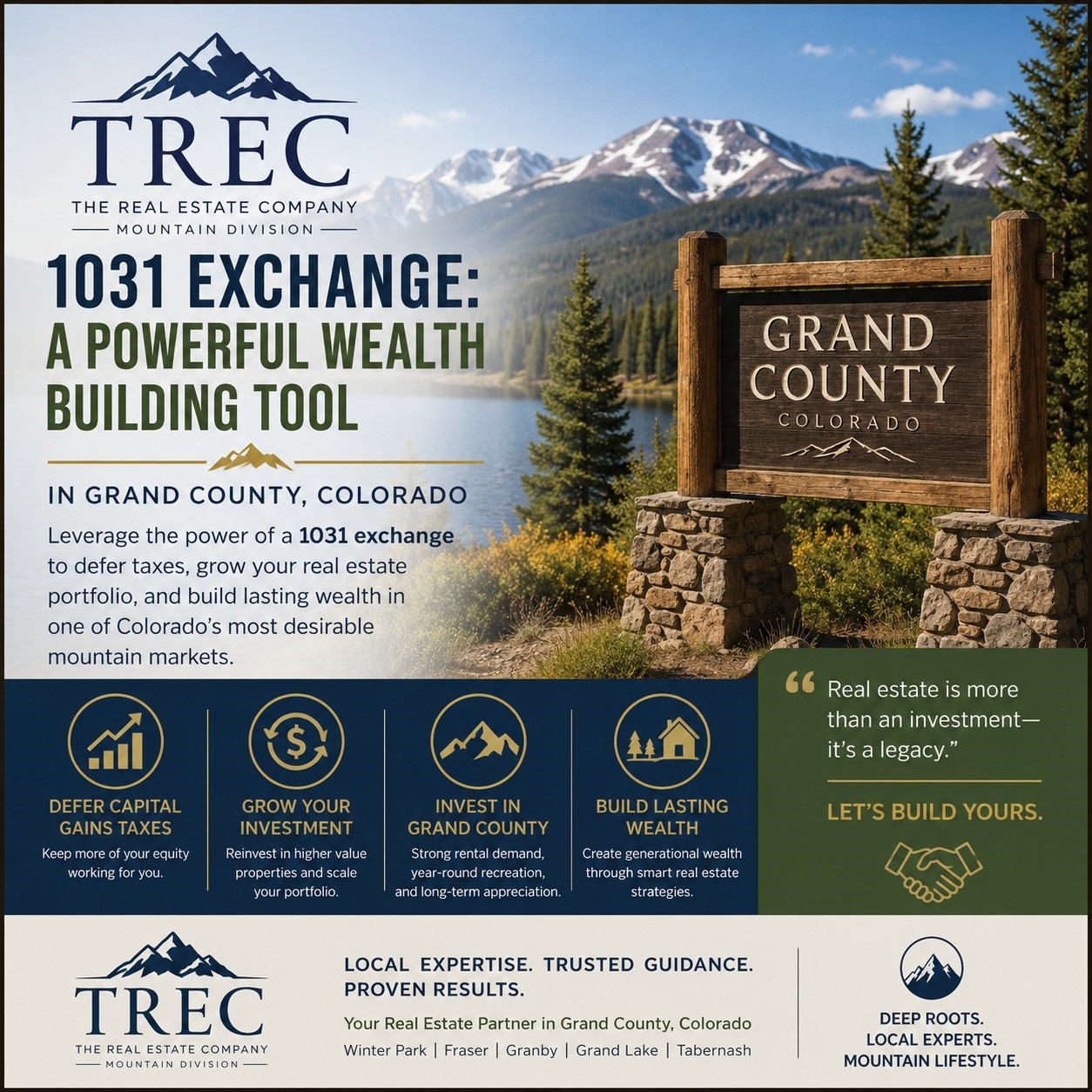
The Section 1031 Tax-Deferred Exchange is the single most powerful investment tool available to U.S. property owners for wealth building and estate planning — and it is reshaping how our clients think about their Grand County holdings.
At The Real Estate Company Mountain Division, we have seen the 1031 exchange become one of the most important strategies in our market. Owners are using it to trade up from condos to homes, roll depreciated rental property into resort holdings here in Grand County, and reposition equity without giving a third of every dollar to the IRS first. If you own investment property in Winter Park, Fraser, Granby, or anywhere in Grand County, this guide is written specifically for you.
Why the 1031 exchange matters more in Grand County than almost anywhere
The combination of federal capital gains tax at up to 20%, Colorado state tax at 4.4%, and depreciation recapture at 25% means a Grand County property owner selling a significantly appreciated investment could easily surrender 30–35 cents of every dollar gained to taxes before they can redeploy a single dollar into their next opportunity.
A 1031 exchange eliminates that friction — for now. By rolling the sale proceeds of your relinquished property directly into a like-kind replacement property through a Qualified Intermediary, you defer every dollar of that tax liability and convert what would have been tax dollars into investment dollars. The result is essentially an interest-free loan from the federal government — reinvested capital that continues compounding in your favor rather than being surrendered at closing.
How the exchange works: the critical timeline
The 1031 exchange is governed by strict IRS timing rules. Miss a deadline by a single day — even if that day is Christmas or a Sunday — and the exchange is disqualified. Here is the sequence exactly as the IRS requires it:
-
1
Engage a Qualified Intermediary before closing
The QI must be in place before the relinquished property closes. Your attorney, accountant, or broker cannot serve as QI — they are disqualified persons under IRS rules. Our team can connect you with experienced, bonded QI partners who operate regularly in the Grand County market.
-
2
Close on the relinquished property — day zero
Sale proceeds go directly to the QI, never to you. Constructive receipt of funds at any point disqualifies the exchange entirely and triggers all capital gains, plus potential penalties and interest.
-
3
45-day identification period
You have exactly 45 days from the close of the relinquished property to identify your replacement property or properties in writing. You may identify up to three properties. The clock does not stop for weekends or holidays.
-
4
180-day closing window
You must close on the replacement property within 180 days of the relinquished property closing, or the due date of your tax return for that year — whichever comes first. Any exchange initiated after mid-October requires a tax filing extension to preserve the full 180 days.
The 100% deferral rule of thumb
To defer 100% of your capital gains — not just a portion — three conditions must all be satisfied simultaneously. Missing any one of them results in partial or full taxable boot:
Trade even or up in value
Replacement property must be equal or greater in value than the relinquished property
Trade even or up in equity
All net proceeds from the sale must be reinvested — no cash left over
Trade even or up in debt
New mortgage must equal or exceed the mortgage on the relinquished property
Questions our Grand County clients ask most
-
Can I trade a condo for a single-family home in Grand County?
Yes — as long as both properties are held for investment or income production. A condo-to-home exchange, vacant land to condo, or rental property to resort investment are all valid like-kind exchanges under Section 1031.
-
Can I exchange my second home?
Not automatically. To qualify, the property must have been held for investment or income production — not personal use. If you have rented the property and treated it as an investment on prior tax returns, it likely qualifies. Personal-use vacation homes typically do not. Your tax advisor and QI can advise on conversion strategies.
-
-
Can I sell a rental property in Denver and exchange into a Grand County resort property?
Absolutely — and this is one of the most powerful applications of the 1031 exchange. Like-kind exchanges can move equity anywhere in the United States. We regularly work with buyers who are rolling depreciated urban rental properties into high-performing resort investments here in Winter Park and Granby.
-
What if my target property is still under construction?
A reverse exchange combined with an improvement exchange allows construction improvements to be included — but the 180-day window still applies and the property must be complete and closed within that period. Careful planning with your QI is essential.
-
What is a reverse 1031 exchange and when does it apply in Grand County?
A reverse exchange allows you to acquire the replacement property before your relinquished property sells — critical in Winter Park's second-home market where contingent offers are rarely accepted. The QI takes title to the replacement property through an Exchange Accommodation Titleholder entity while your existing property sells. QI fees run approximately $5,000 versus $1,000 for a conventional exchange — a meaningful but often justified cost in a competitive market.
Structure, not intent, determines a valid exchange
The IRS does not care what you intended to do. If the exchange is not structured correctly — proper QI in place, proceeds never touching your hands, identification submitted in writing before the 45-day deadline — the exchange is disqualified. The result is full capital gains, plus penalties, plus interest back to the year it was due. There is no appealing good intentions to the IRS. Get the structure right from day one.
Why Grand County is one of the best 1031 destination markets in Colorado
The 1031 exchange doesn't just defer your tax liability — it compounds your investment position. And few markets in Colorado offer the combination of long-term appreciation fundamentals, STR income potential, and lifestyle demand that Grand County delivers. Here is why our market consistently attracts 1031 investors from across the country:
Proven appreciation
Limited developable land and consistent demand have driven strong value growth across Winter Park, Fraser, and Granby
STR income potential
Top 10% of STR properties generate $9,843+ monthly — one of the strongest resort rental markets in Colorado
Year-round demand
Winter Park Resort, mountain biking, hiking, and four-season recreation drive consistent occupancy beyond ski season
Front Range proximity
67 miles from Denver — close enough for weekend demand, far enough to feel like a true mountain escape
At The Real Estate Company Mountain Division, we have been facilitating 1031 exchanges in this market for years. We understand which properties qualify, which subdivisions perform best as STR investments, which HOAs permit short-term rentals without restriction, and how to structure an offer in a market that rarely accepts contingencies. Our QI network, our local knowledge, and our $835M in closed transaction experience are available to you from the first conversation.
If you own investment property and are thinking about your next move — whether that's trading up within Grand County, rolling urban rentals into resort holdings, or exploring a reverse exchange on a specific property you don't want to lose — we'd like to have that conversation with you.
Ready to talk 1031 strategy for your Grand County investment?
Serving Winter Park, Fraser, Granby, Tabernash, Grand Lake, and all of Grand County.
-