Policy watch · November 2026 ballot
Colorado voters will decide the right to hunt and fish this November -- here is what it means for property owners in Grand County
The Real Estate Company - Mountain Division
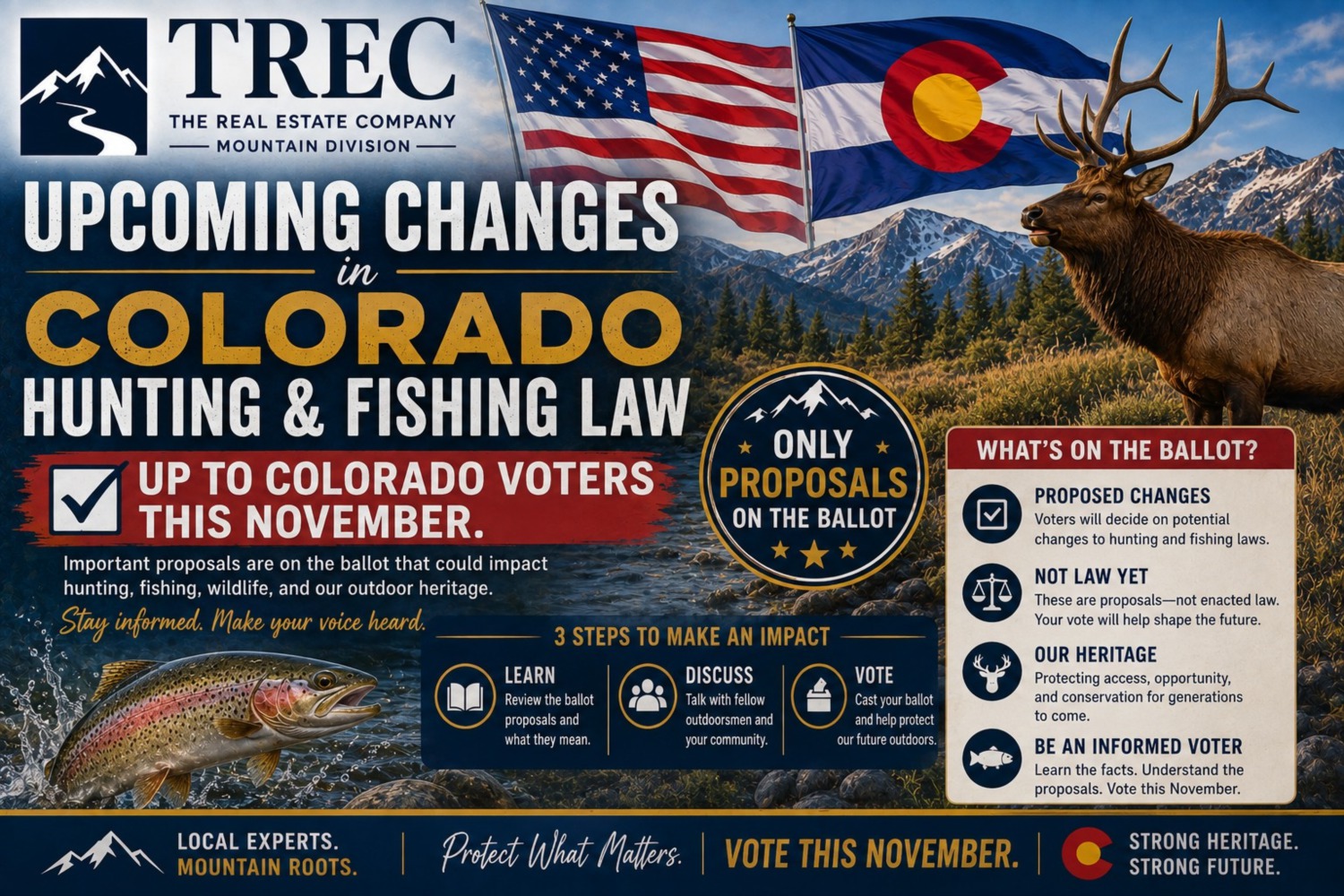
Colorado voters will head to the polls in November with a ballot measure that may sound straightforward -- a constitutional right to hunt and fish -- but carries implications that reach well beyond the field and stream. For buyers, sellers, and property owners in Grand County, understanding Initiative 302 and what it could mean for the outdoor recreation economy, wildlife management, and the rural Colorado lifestyle that drives real estate demand in our market is worth your attention.
At The Real Estate Company Mountain Division, we track everything that shapes the value of property in Grand County -- including the ballot measures that will define how this landscape is managed for decades to come.
Initiative 302 -- Colorado November 2026 ballot
Constitutional right to hunt and fish using traditional methods
The measure would enshrine the right to hunt and fish "by the use of traditional methods" in the Colorado constitution, applying to species managed by the state. It would not include the right to hunt endangered species or species illegal to hunt under federal law -- so gray wolves and lynx would remain protected. It would also constitutionally designate hunting and fishing as the state's "preferred method" of managing wildlife populations. To pass, the amendment needs at least 55% of the vote.
Hunting and fishing are already legal in Colorado and managed by Colorado Parks and Wildlife. The amendment does not open new seasons or remove existing regulations -- seasons, quotas, and science-based management structures would remain in place. What it does is create a constitutional barrier that makes it significantly harder for future ballot initiatives, the legislature, or anti-hunting groups to restrict hunting and fishing rights in Colorado.
Backers of Initiative 302 -- including Coloradans for Responsible Wildlife Management and the Wisconsin-based International Order of T. Roosevelt -- frame the amendment as a protection for science-based wildlife management and a safeguard against activist ballot initiatives and lawsuits that seek to curtail hunting rights incrementally.
The argument is straightforward: around two dozen states have already adopted similar constitutional protections, and in those states, challenges to hunting access have been significantly harder to advance. The amendment's supporters point to a Nebraska precedent where the state's constitutional right to hunt allowed the governor to veto a mountain lion hunting ban -- citing the constitutional protection as the basis.
Opposition to Initiative 302 centers on two main concerns -- the scope of the "traditional methods" language and the potential restriction of future wildlife management flexibility.
Critics argue that the undefined phrase "traditional methods" could be used to challenge existing Colorado voter-approved bans on practices like baiting and steel-jawed leghold traps. If the amendment passes, opponents warn there could be a rush to the courthouse by proponents of those "traditional methods" arguing that the constitutional right invalidates the existing bans.
Opponents also argue the amendment would tie the hands of Colorado Parks and Wildlife, the legislature, and future citizen ballot initiatives in responding to changing ecological conditions -- including issues like chronic wasting disease, drought impacts on habitat, and the management of reintroduced species like gray wolves.
Supporters argue
Science-based wildlife management is protected. Hunting and fishing remain accessible as Colorado's preferred management tool. Constitutional barrier against activist lawsuits and ballot initiatives that seek to restrict access incrementally.
Opponents argue
Undefined "traditional methods" language could challenge existing voter-approved bans. Restricts future flexibility of CPW, legislature, and citizen initiatives. Could complicate management of reintroduced species like gray wolves.
Grand County is one of Colorado's premier outdoor recreation destinations -- and hunting and fishing are not peripheral activities here. They are woven into the economy, the culture, and the identity of communities from Granby and Grand Lake to Tabernash and Fraser. The outcome of Initiative 302 has real and tangible implications for property in our market.
Grand County's Blue Ribbon trout fishery on the Fraser River, Lake Granby, and Granby Reservoir drive significant tourism and second-home demand. Stable fishing access supports property values directly
Elk, deer, and upland bird hunting generate millions in local economic activity annually. Properties with access to hunting grounds carry meaningful value premiums in Grand County
The rural Colorado lifestyle that draws buyers to Grand County -- including hunting, fishing, and access to Arapaho National Forest -- is a fundamental driver of property demand and long-term values
Parcels with hunting access, fishing rights, or adjacency to public land already command significant premiums in Grand County. The regulatory environment around those activities shapes their long-term value
For buyers evaluating rural properties, land parcels, or second homes in Grand County with recreational use in mind, the regulatory framework around hunting and fishing is not a background issue -- it is a direct factor in how those properties are used, enjoyed, and valued. A constitutional protection for hunting and fishing rights provides a layer of long-term certainty for buyers whose investment thesis includes recreational land use.
For sellers of properties with hunting access or fishing frontage, the outcome of this ballot measure will shape how buyers perceive the long-term security of those amenities -- and by extension, what they are willing to pay for them.
Colorado's outdoor recreation industry generates over $28 billion annually and supports hundreds of thousands of jobs statewide. In mountain counties like Grand County, that economy is not just backdrop -- it is the primary driver of tourism, hospitality, second-home demand, and the lifestyle appeal that underpins real estate values across every community from Winter Park to Grand Lake.
Any ballot measure that affects how Colorado manages its wildlife and public lands is, by extension, a ballot measure that affects the real estate market in communities built on outdoor recreation. That is not an overstatement -- it is the direct economic chain that connects wildlife policy to property values in Grand County.
We are not here to tell you how to vote on Initiative 302. Both sides of this debate have legitimate arguments rooted in genuine concern for Colorado's wildlife and outdoor heritage. What we are here to do is make sure our clients understand what is on the ballot, what is at stake, and how the outcome of November's vote could shape the landscape -- literally and figuratively -- of the market they are buying or selling in.
At The Real Estate Company Mountain Division, we track policy, ballot measures, wildlife management decisions, and development plans because all of it feeds into the market intelligence we bring to every client conversation. That is what it means to be the most knowledgeable real estate team in Grand County.