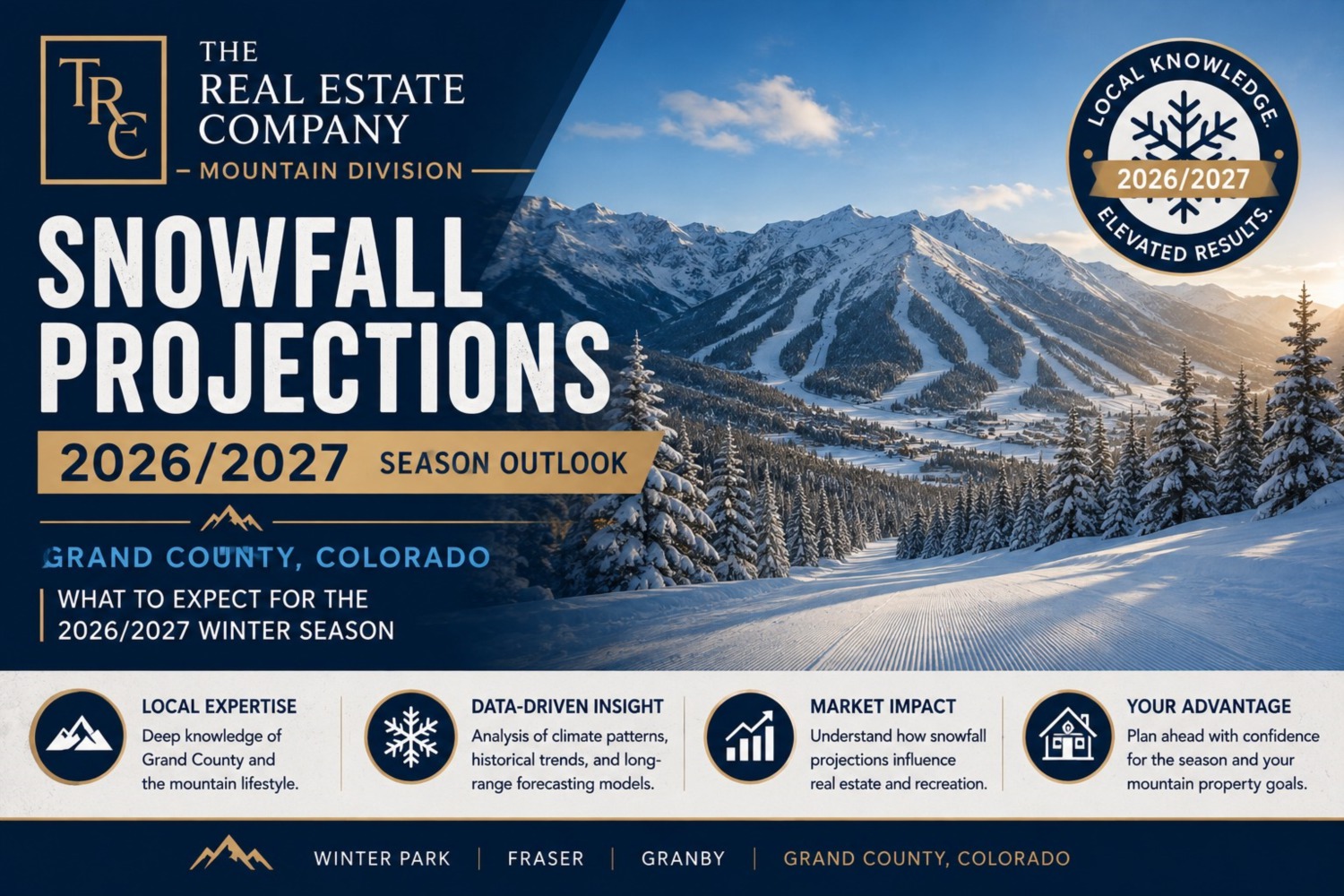


Grand County · Winter 2026-27
Forecasters say this could be the strongest El Niño on record. Colorado's climatologists say that does not guarantee a big snow year. Here is what the science actually says, and why Winter Park is still where I would want to own this winter.
On September 10, 2026, NOAA's Climate Prediction Center put it plainly: "El Niño is strengthening, with a greater than 90% chance of a very strong event" this fall and winter. The same update gave a 75% chance that the October to December period would set a new record, exceeding every El Niño since 1950. Ocean temperatures in the key Niño-3.4 region were already running 1.8°C above normal in August.
That is why "super El Niño" is showing up in every ski conversation right now. If you are thinking about buying or selling in Colorado's mountain towns, it is a fair question: does a historic El Niño mean a historic snow year? The honest answer, from the people who study Colorado's climate for a living, is that it might, but you should not count on it.
What El Niño usually does, and why Colorado is tricky
El Niño is a warming of the tropical Pacific that shifts the winter jet stream. NOAA's Climate.gov explains that it tends to bring wetter, cooler winters to the southern United States and warmer, drier ones to the northern tier, and it stresses that these effects are "a matter of probability, not certainty." Colorado sits in the middle of that pattern, which is exactly why the signal here is muddy.
Peter Goble, Assistant State Climatologist at the Colorado Climate Center at Colorado State University, wrote on September 3, 2026 that Colorado is generally wetter during El Niño years, especially in fall and spring. But he was clear about snowpack: "the link between the El Niño-Southern Oscillation (ENSO) and peak seasonal snowpack levels in Colorado is weak." Only the southern basins, such as the San Juan and Rio Grande, show what he calls "a loose positive correlation."
The track record of past super El Niños makes the same point. Goble counts three since 1950: 1982-83, 1997-98 and 2015-16. The first delivered huge snowfall to Colorado. The other two produced roughly average conditions. In his words, "Drawing firm conclusions from three events is unreliable."
Three super El Niños, one huge Colorado snow year, two average ones. That is the whole history.
The forecast leans wet, with a warm catch
NOAA's seasonal outlook, issued September 17, 2026, points to a "wet signal across the southern and central" United States through the winter, and it says a very strong El Niño "would overwhelm" many of the other patterns that usually shape our weather. That leans in Colorado's favor, especially for the southern half of the state.
The catch is temperature. State Climatologist Russ Schumacher told the Denver Gazette in June that a super El Niño brings warmth along with moisture, and he noted that Colorado's water year had been the warmest on record and among the ten driest. More moisture is welcome, but in a warm pattern some of it can fall as rain at lower elevations instead of snow.
Why Winter Park does not need to win the weather lottery
This is where I think buyers should focus. The best mountain markets are the ones that perform in an average winter, not just a great one. Winter Park checks that box, and it is why I consider it Colorado's number one ski destination right now.
Start with elevation. Winter Park Resort describes its base areas at 9,000 and 8,800 feet, high enough to hold snow when warm storms push snow levels up. Add snowmaking: Alterra Mountain Company says Winter Park is in a multi-year rebuild of its snowmaking system, with more automated fan guns this season to support earlier openings and double the snowmaking capacity on Lower Hughes. Snowmaking is the hedge against exactly the uncertainty the climatologists describe.
Then there is access. The resort is 67 miles from Denver and reachable by Amtrak's Winter Park Express ski train, and the Town of Winter Park points to a $5 million investment to study mountain passenger rail between Denver and Craig. The resort itself bills Winter Park as the "#1 Ski Resort in North America." Whatever this winter brings, those advantages do not melt in March.
What it means if you are buying or selling
For buyers, do not let one forecast set your timeline or your offer. A big snow year can bring more competition from buyers who visited on a powder day, and an average year can bring more room to negotiate. Neither changes the long-term reasons to own here. If rental income matters to you, underwrite it on a normal season, not a record one.
For sellers, winter is when many buyers are in town and seeing the mountains at their best. If you are thinking about listing, getting ready in the fall puts your home in front of them when they arrive. And if this does turn into a 1982-83 kind of winter, you will want to be on the market, not still deciding.
The forecast for this winter is genuinely uncertain, and anyone who promises otherwise is guessing. What is not uncertain is that Winter Park sits high, makes its own snow and is easy to reach. That combination holds its value in any El Niño.
If you would like to talk through how this winter could affect your plans to buy or sell, I am happy to walk through it with you.
Chad Chapel
Mountain Property Specialist
The Real Estate Company -- Mountain Division · Winter Park, Colorado